
Fresh vs. Aged Kimchi: How to Choose the Best Kimchi for Your Gut
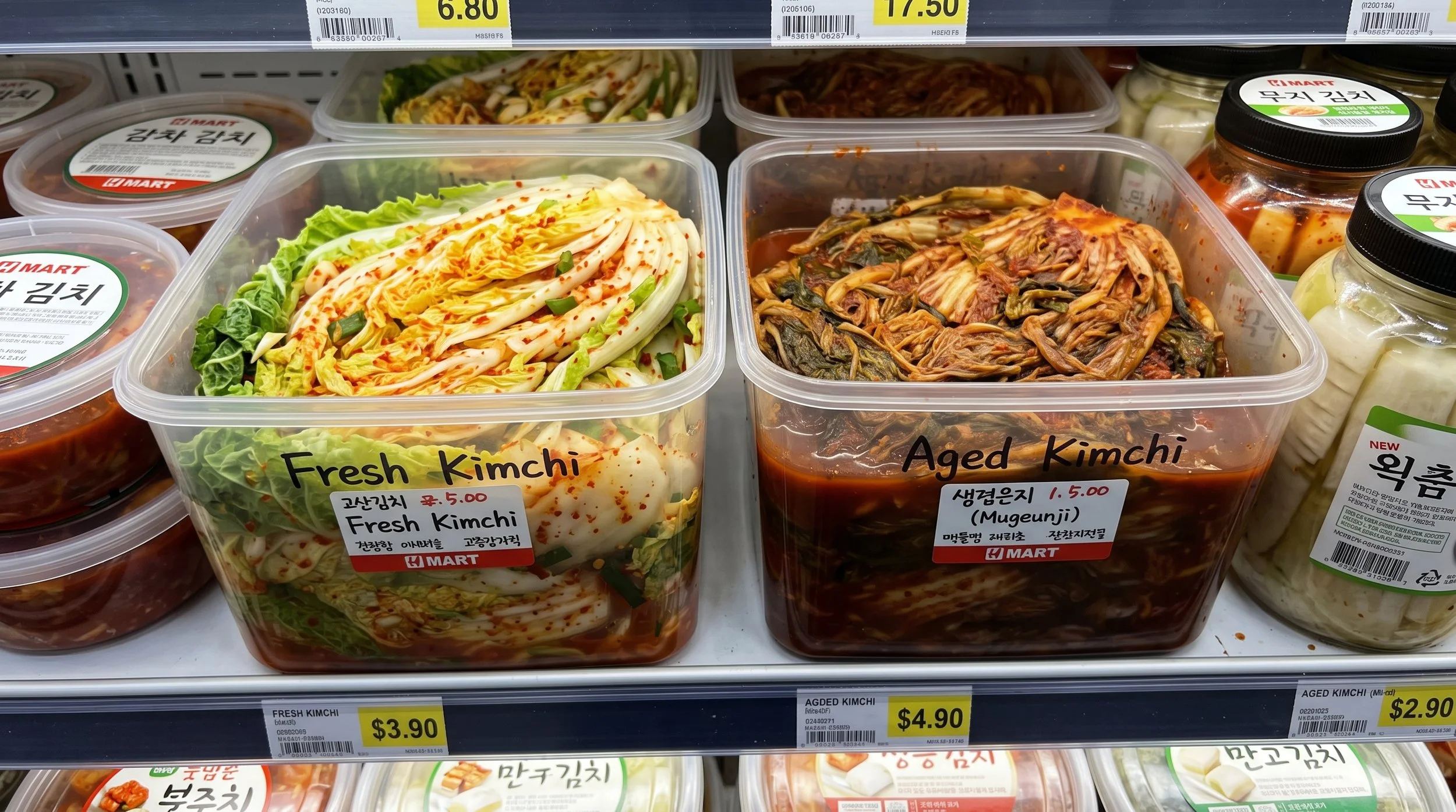
The best kimchi for your gut depends on what you need: fresh kimchi is crunchy, bright, and higher in vitamin C, while aged kimchi (mugeunji) has fermented for months and is rich in the lactic acid bacteria behind kimchi's probiotic benefits. Both are fermented, both support digestion, and in Traditional Korean Medicine both have a place at the table.
Walk into any H Mart and you'll find an entire wall of kimchi. Here's how Young Choi, LAc, of YSC Acupuncture, shops that aisle — and why this centuries-old Korean staple is worth a place in your weekly routine.
Why Fermentation Is What Matters
Every kimchi you'll see at the store is fermented, and that fermentation is the point. As kimchi ferments, lactic acid bacteria (LAB) multiply and become the dominant microbes, while the bacteria that cause spoilage are suppressed. That's why researchers describe kimchi as “a vegetable probiotic food” that offers health benefits in a similar way to yogurt.[1] Its reported benefits include support for regularity, colorectal health, immune function, and cholesterol balance.[1]
Kimchi also brings fiber and nutrients from its whole-food ingredients. Napa cabbage, garlic, ginger, and red pepper contribute vitamin C, beta-carotene, B vitamins, minerals, and dietary fiber, plus plant compounds like gingerol and capsaicin.[2] Fiber feeds the healthy bacteria already in your gut, and the probiotics add more — which is why kimchi is often described as a gut and immune food.
Fresh Kimchi vs. Aged Kimchi (Mugeunji)
When you're choosing, you're really choosing how far along the fermentation is:
Fresh kimchi: Made to eat right away. It's crunchy and bright, and because it hasn't been fully broken down by fermentation yet, it holds more of its vitamin C. A good choice if you like a lighter, crisp flavor.
Aged kimchi (mugeunji): Fermented for months — Koreans joke that it's been fermenting for a thousand years. During that time the lactic acid bacteria keep multiplying, and that's where its deep, tangy flavor and its probiotic richness come from. It's wonderful in stews like kimchi jjigae.
In Korean medicine, slightly sour, fermented foods are seen as supportive of digestion. So if gut health is your main goal, a well-fermented kimchi is a great place to start. If you prefer crunch, fresh kimchi still brings fiber, vitamins, and early-stage fermentation.
Three Kinds of Kimchi to Look For
1. Napa cabbage kimchi (baechu kimchi)
Authentic kimchi is made from napa cabbage — not the round green or white cabbage common in American supermarkets. If the label says whole cabbage or napa cabbage, you're getting the classic texture and flavor. Fresher versions haven't fermented as long; aged versions will be softer and more sour.
2. Aged kimchi (mugeunji)
Deep, tangy, and spicy. This is the long-fermented kimchi Korean families save for cooking and for the richest probiotic benefit.
3. White kimchi (baek kimchi)
100% non-spicy. White kimchi is salted and kept in brine for a long time, so it still delivers fermentation's probiotic benefits with zero heat — a great option for children, anyone sensitive to spice, or anyone easing into fermented foods.
It's Gimjang Season
Late fall into winter is gimjang season — the traditional Korean practice of families and neighbors gathering to make large batches of kimchi to last through the whole winter, long before refrigeration made kimchi available year-round. The tradition is so central to Korean life that UNESCO recognized “Kimjang, making and sharing kimchi” as part of humanity's Intangible Cultural Heritage in 2013.[3]
At YSC Acupuncture, we see gimjang as the perfect picture of our philosophy: prevention is the cure. Generations of Korean families prepared for the coldest months with foods that nourish the gut and support the body through winter.
How to Enjoy Kimchi as Part of Your Wellness Journey
Start small. A few bites with a meal and let your body adjust to fermented foods.
Pair it the traditional way: with rice, soup, or a bowl of nourishing beef bone broth.
Use aged kimchi in cooking (jjigae, fried rice) and fresh kimchi as a side.
Keep an eye on sodium. Kimchi is salted, so if you're watching blood pressure, enjoy it in moderation as part of a balanced meal.[4]
Food is one part of the picture. If bloating, irregularity, or low energy keep coming back, they're often your body's way of pointing to an underlying pattern. At YSC Acupuncture, we look at the root cause and support digestion with acupuncture and GM Choi's Herbal Medicine, tailored to your constitution because every body is different.
Frequently Asked Questions
-
Both support gut health, but aged kimchi (mugeunji) has fermented longer, so its lactic acid bacteria have had more time to multiply — that's where kimchi's probiotic properties come from. Fresh kimchi is crunchier and higher in vitamin C. Many people enjoy both: fresh as a side and aged in cooking.[1]
-
Mugeunji is aged kimchi that has fermented for months. It has a deep, tangy, spicy flavor, a softer texture, and is rich in lactic acid bacteria. It's commonly used in stews and braised dishes.
-
Yes. Kimchi is fermented by lactic acid bacteria, which become dominant during fermentation. Researchers describe kimchi as a vegetable probiotic food that offers benefits in a similar way to yogurt.[1]
-
White kimchi (baek kimchi) is a non-spicy kimchi made without red pepper. It's salted and kept in brine, so it still offers the probiotic benefits of fermentation with zero heat — a good choice for children or anyone sensitive to spice.
-
Napa cabbage is the traditional base of Korean kimchi because of its tender leaves and crisp ribs, which absorb seasoning and hold their crunch. It's different from the round green or white cabbage common in American supermarkets.
-
Gimjang (also spelled kimjang) is the Korean tradition of making large batches of kimchi together in late fall to last through winter. UNESCO added it to its list of Intangible Cultural Heritage in 2013.[3]
-
Kimchi is salted during preparation, so it does contain sodium. If you're watching your blood pressure or sodium intake, enjoy kimchi in moderate portions as part of a balanced meal.[4]
This article is educational and reflects Traditional Korean Medicine principles as practiced at YSC Acupuncture. It is not a substitute for individualized medical advice. Schedule a consultation with YSC Acupuncture to discuss your digestion and constitution directly.
Schedule a virtual herbal medicine consultation at YSCAcupuncture.com so we can get to the root cause of your digestive symptoms.
Sources
1. Park, K.-Y., Jeong, J.-K., Lee, Y.-E., Daily, J. W. “Health benefits of kimchi (Korean fermented vegetables) as a probiotic food.” Journal of Medicinal Food 17, no. 1 (2014): 6–20. pubmed.ncbi.nlm.nih.gov/24456350
2. Patra, J. K., Das, G., Paramithiotis, S., Shin, H.-S. “Kimchi and other widely consumed traditional fermented foods of Korea: A review.” Frontiers in Microbiology 7 (2016): 1493. pmc.ncbi.nlm.nih.gov/articles/PMC5039233
3. UNESCO. “Kimjang, making and sharing kimchi in the Republic of Korea.” Representative List of the Intangible Cultural Heritage of Humanity (2013). ich.unesco.org/en/RL/00881
4. American Heart Association. “How much sodium should I eat per day?” heart.org