
Is Korean Herbal Medicine Just Chinese Medicine Translated? Not Quite
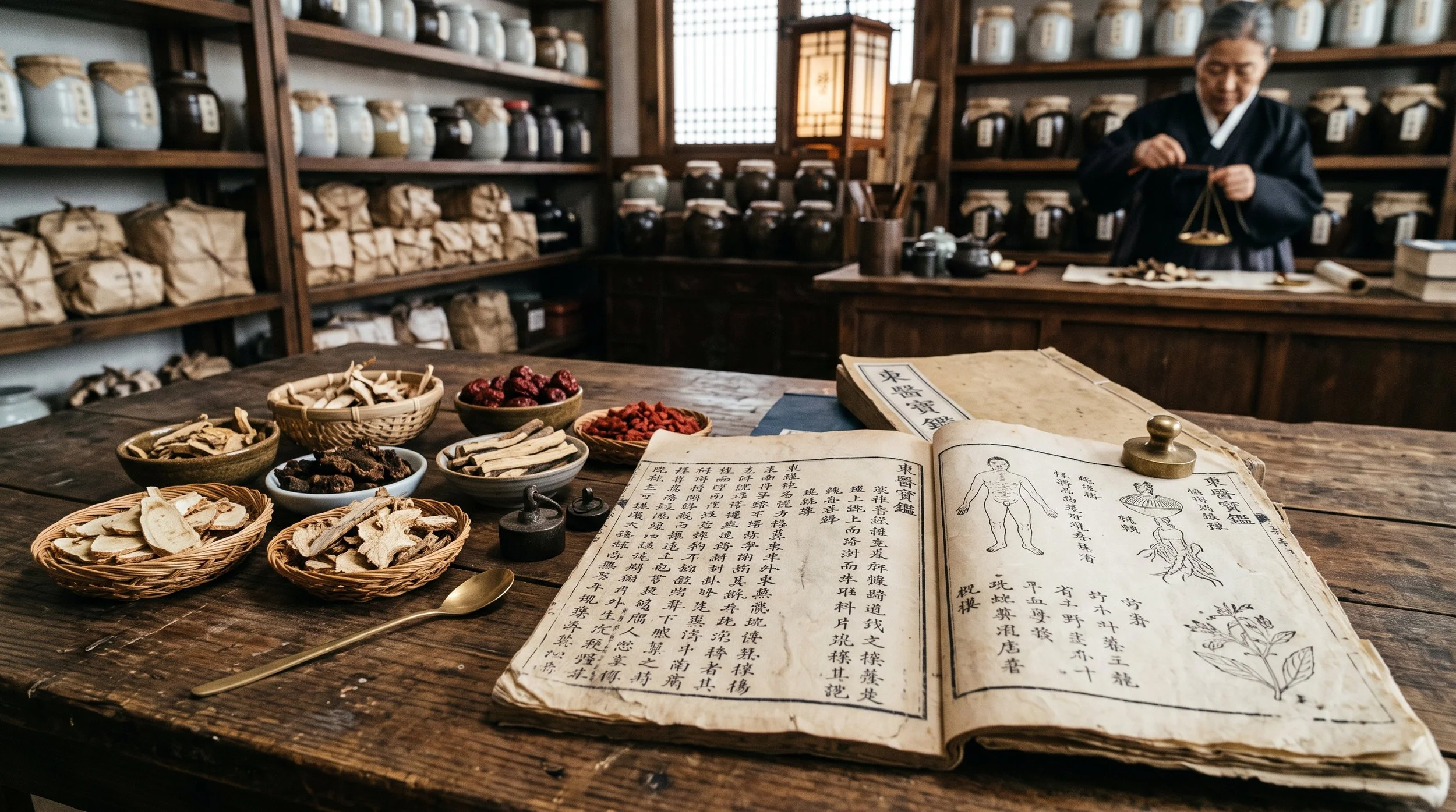
Many people assume Korean herbal medicine is simply Chinese medicine translated into Korean. It's not. Traditional Korean Medicine (TKM) shares foundational theories with Traditional Chinese Medicine (TCM) — but Korea has spent more than a thousand years developing its own diagnostic methods, classical texts, and herbal formulas into a distinct medical tradition.
What TKM and TCM Have in Common
Traditional Korean Medicine and Traditional Chinese Medicine are built on the same theoretical foundation: yin and yang, the five elements, qi, blood, and the meridian system. These shared principles are why the two traditions can look similar from the outside, and why the assumption that one is just a translation of the other is such a common misconception.
Where Korean Medicine Charts Its Own Course
One of the biggest differences is how much weight TKM places on individual constitution. Rather than treating everyone with the same diagnosis the same way, Traditional Korean Medicine focuses on understanding why a particular person developed a condition in the first place. This is reflected in distinctly Korean developments like Sasang constitutional medicine, a framework that tailors diagnosis and treatment to a patient's individual constitutional type rather than applying a single standardized protocol.[1]
A 2014 review in Evidence-Based Complementary and Alternative Medicine identifies Sasang constitutional medicine as representative of genuinely Korean medical developments, describing an individualized approach built around each patient's underlying constitutional traits rather than a one-size-fits-all diagnosis.[2]
Korea's Own Texts, Formulas, and Diagnostic Methods
Korea also developed its own classical herbal formulas, diagnostic methods, and medical texts. The most famous is the Donguibogam, compiled by royal physician Heo Jun and first published in 1613. It organized centuries of medical knowledge into a distinctly Korean system, and in 2009 it was inscribed on UNESCO's Memory of the World Register in recognition of its historical and medical significance.[3]
Same Roots, Two Distinct Traditions
Although many herbs do overlap between Korean and Chinese medicine, preparation methods, herb combinations, dosages, and clinical preferences often differ. In other words: TKM and TCM share the same roots, but over more than a thousand years, they've grown into two distinct traditions.
That same principle — treating the person, not just the diagnosis — is exactly what shapes GM Choi's Herbal Medicine™ at YSC Acupuncture. Every formula is built around your individual constitution and pattern, not a standardized prescription, because that's the philosophy Traditional Korean Medicine has carried for generations: prevention is the cure, and every body deserves care built around its own constitution.
This is the first in a series on Traditional Korean Medicine — including how it approaches women's health naturally. Follow along, and in the meantime, read on for a few common questions about how TKM and TCM differ.
Frequently Asked Questions
-
No. While Traditional Korean Medicine (TKM) shares foundational theories with Traditional Chinese Medicine (TCM) — yin and yang, the five elements, qi, blood, and the meridian system — Korea developed its own diagnostic methods, herbal formulas, and medical texts over more than a thousand years, including a distinct emphasis on individualized, constitution-based treatment.
-
TKM is a distinct East Asian medical tradition that shares foundational theories with Traditional Chinese Medicine but has evolved its own classical texts, herbal formulas, and diagnostic approach — most notably a stronger emphasis on treating each patient according to their individual constitution rather than a standardized diagnosis.
-
The Donguibogam is Korea's most famous classical medical text, compiled by royal physician Heo Jun and published in 1613. It organized centuries of medical knowledge into a Korean-specific system and was inscribed on UNESCO's Memory of the World Register in 2009.[3]
-
Rather than treating every patient with the same diagnosis identically, Traditional Korean Medicine places significant emphasis on understanding why a particular person developed a condition, based on their individual constitution. This principle is reflected in distinctly Korean developments such as Sasang constitutional medicine, which tailors treatment to a patient's constitutional type.[1][2]
-
Many herbs do overlap between the two traditions, but preparation methods, herb combinations, dosages, and clinical preferences often differ. The two systems share the same roots but have grown into two distinct traditions over more than a thousand years.
-
At YSC Acupuncture, this Korean emphasis on individual constitution is central to how we practice. GM Choi's Herbal Medicine™ is built around your specific pattern rather than a standardized formula, reflecting the same constitution-first philosophy that has defined Traditional Korean Medicine for generations.
This article is educational and reflects Traditional Korean Medicine principles as practiced at YSC Acupuncture. It is not a substitute for individualized medical advice. Schedule a virtual herbal medicine consultation with YSC Acupuncture to discuss your symptoms and constitution directly.
Sources
1. Kim, Y., et al. “Sasang Constitutional Medicine as a Holistic Tailored Medicine.” Evidence-Based Complementary and Alternative Medicine (2009). pubmed.ncbi.nlm.nih.gov/19745007
2.“Recent Developments in Korean Medicine.” Evidence-Based Complementary and Alternative Medicine, Hindawi (2014). hindawi.com/journals/ecam/2014/740515
3. “Donguibogam: Principles and Practice of Eastern Medicine.” UNESCO Memory of the World Register, inscribed 2009. unesco.org/en/memory-world/donguibogam-principles-and-practice-eastern-medicine