
The Herbs GM Choi's Herbal Medicine™ Uses for PMOS (Formerly PCOS)
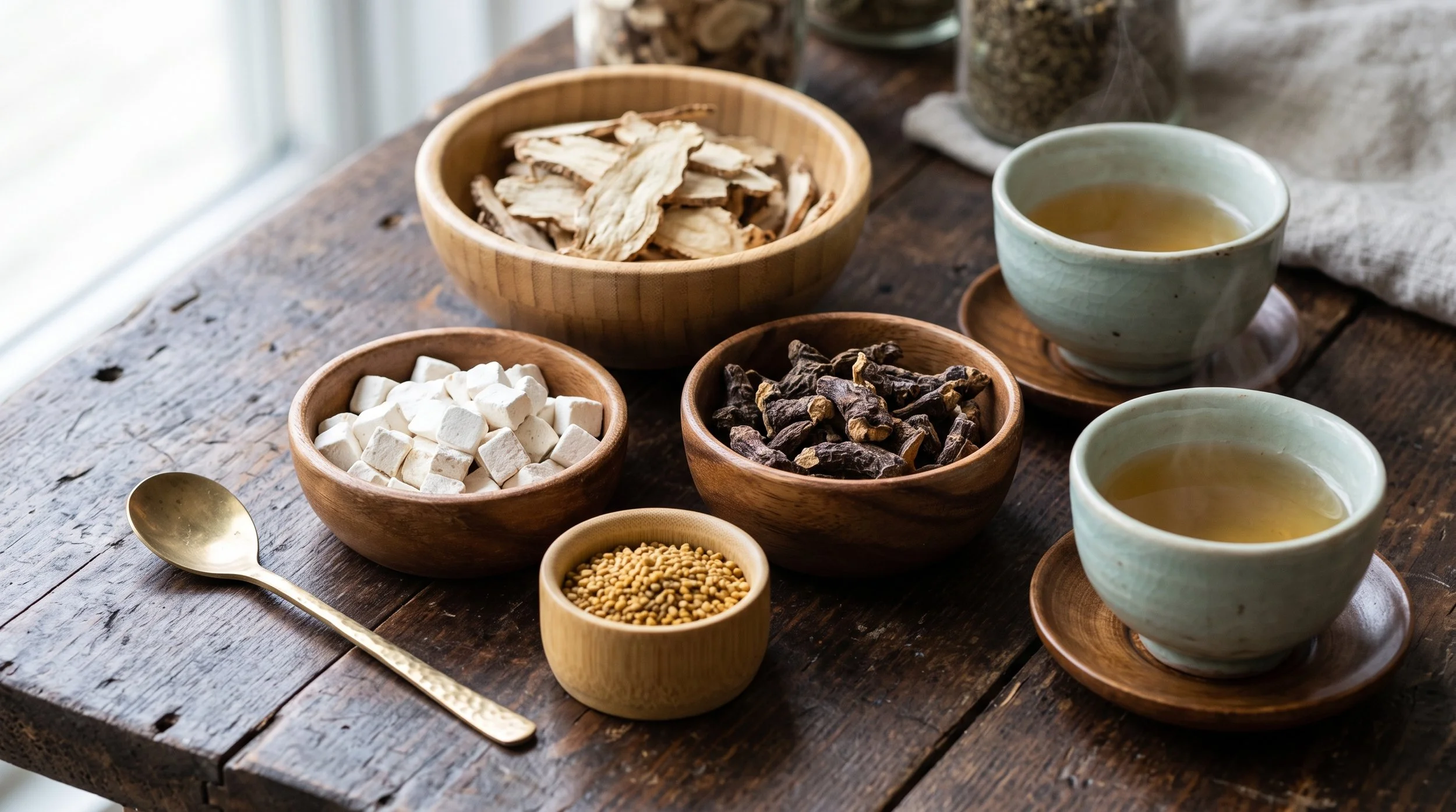
In GM Choi's Herbal Medicine™, several herbs are commonly used to support women with PMOS (formerly known as PCOS) — but they're never prescribed the same way twice. Herbal formulas are always customized to the individual; there's no one-size-fits-all prescription for PMOS.
Angelica Root (당귀) — to Nourish and Regulate Blood
Angelica root, called 당귀 in Korean, is used to nourish and help move blood — addressing the blood stasis and blood-deficiency patterns that can contribute to painful or irregular periods. A review in the journal Chinese Medicine identified more than 70 bioactive compounds in Angelica root, including ferulic acid and ligustilide, with documented anti-inflammatory and antioxidative activity.[1]
Poria (백복령) — to Reduce Dampness
Poria, or 백복령, is used to help clear the phlegm-and-dampness pattern often linked to weight gain and cyst formation in PMOS. A pharmacological review notes poria has traditionally been used for its diuretic and tonic effects, and documents “marked anti-inflammatory activity” along with immune-modulating polysaccharides.[2]
Cyperus Rhizome (향부자) — to Regulate Qi
Cyperus rhizome, or 향부자, is used to regulate qi — addressing the qi-stagnation pattern that chronic stress can create, which often shows up as irregular periods. A systematic review describes cyperus rhizome as a foundational herb in gynecology, historically used to “soothe the liver,” regulate qi, and relieve menstrual pain, with research on its main compound, α-cyperone, pointing to estrogen-like and uterine-modulating activity.[3]
Dodder Seed (토사자) — to Support Reproductive Health
Dodder seed, or 토사자, is used to support the kidney-deficiency pattern connected to ovulation, fertility, and hormone balance. A study using animal and cell models found that flavones extracted from dodder seed helped regulate estrogen, progesterone, and prolactin receptor activity at the maternal-fetal interface — early, mechanism-level research, not a clinical guarantee, but consistent with dodder seed's traditional reproductive-health use.[4]
Why Formulas Are Always Personalized
These four herbs are commonly used for PMOS, but almost never in the same combination or dose. Herbal formulas are always customized to the individual — there's no one-size-fits-all prescription. The goal isn't just to manage symptoms; it's to address the root imbalance and help your body function more naturally, alongside acupuncture, nutrition, and lifestyle support.
Frequently Asked Questions
-
Herbs commonly used in GM Choi's Herbal Medicine for PMOS include Angelica root (당귀) to nourish and move blood, poria (백복령) to reduce dampness, cyperus rhizome (향부자) to regulate qi, and dodder seed (토사자) to support reproductive health — always combined and dosed based on your individual pattern.
-
Angelica root is used to nourish and help move blood, which supports patterns like blood stasis and blood deficiency that can show up as painful or irregular periods.[1]
-
Poria is used to help clear excess dampness, a pattern in Traditional Korean Medicine often linked to weight gain and cyst formation in PMOS.[2]
-
Cyperus rhizome is used to regulate qi, addressing the qi-stagnation pattern that chronic stress can create and that often shows up as irregular periods.[3]
-
Dodder seed has traditionally been used to support the kidney-deficiency pattern connected to ovulation, fertility, and hormone balance, and early research suggests it may help regulate reproductive hormone activity.[4] As with any herb, its role in your care depends on your individual pattern.
-
No. Even with the same PMOS diagnosis, your formula is built around your individual constitution and pattern. That's why we don't recommend trying to self-prescribe these herbs — some also interact with medications or aren't appropriate during pregnancy. A consultation is the best way to find out what's right for you.
This article is educational and reflects Traditional Korean Medicine principles as practiced at YSC Acupuncture. It is not a substitute for individualized medical advice or your ongoing care with your physician. Schedule a virtual herbal medicine consultation with YSC Acupuncture to discuss your symptoms and constitution directly.
Sources
1. Wei, W.-L., et al. “Bioactivities of major constituents isolated from Angelica sinensis (Danggui).” Chinese Medicine 6, no. 29 (2011). link.springer.com/doi/10.1186/1749-8546-6-29
2. “Chemical Constituents and Pharmacological Properties of Poria cocos.” Planta Medica (2011). pubmed.ncbi.nlm.nih.gov/21347995
3. “Systematic Review of Ethnomedicine, Phytochemistry, and Pharmacology of Cyperi Rhizoma.” Frontiers in Pharmacology (2022). frontiersin.org/journals/pharmacology/articles/10.3389/fphar.2022.965902/full
4. Wu, et al. “Effect of Total Flavones from Cuscuta Chinensis on Anti-Abortion via the MAPK Signaling Pathway.” Evidence-Based Complementary and Alternative Medicine (2018). hindawi.com/journals/ecam/2018/6356190