
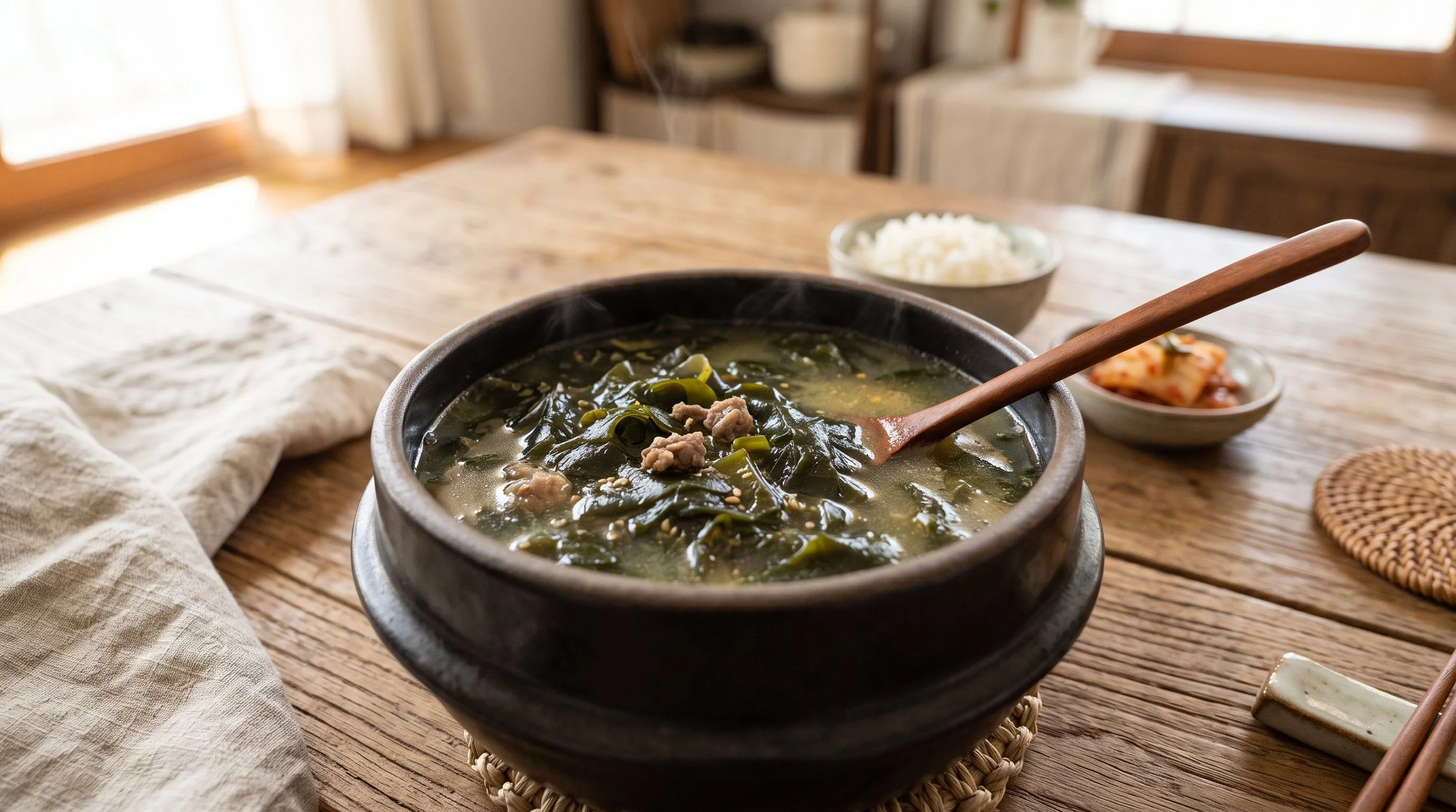
In Korean culture, the first meal after giving birth is almost always miyeok-guk — seaweed soup. Made from rehydrated miyeok (a brown seaweed also known as wakame), it's one of the richest natural sources of iodine and also provides calcium, iron, magnesium, and fucoidan. In Traditional Korean Medicine, it's considered blood-nourishing and is used to help replenish what the body loses after birth.
Here's why new mothers in Korea eat this soup daily for weeks after childbirth, what the nutrition science says, and how to enjoy it safely.
What Is Miyeok-guk?
Miyeok is a dried seaweed. Once it's soaked and rehydrated, it becomes the base of miyeok-guk, a simple, savory soup often made with beef or seafood. Fresh miyeok is harvested off Korea's southern coast from late winter through early spring, when it's most tender — but the dried version you'll find at H Mart is nutrient-dense and available year-round.
The Nutrition Behind Seaweed Soup
Iodine: Seaweed is one of the richest natural sources of iodine, which the body uses to make thyroid hormones. Nursing mothers need more of it — the recommended intake rises to 290 mcg a day during breastfeeding, because breast milk is how a baby gets iodine for healthy development.[1]
Calcium, iron, and magnesium: Minerals that support bones, energy, and recovery — iron in particular matters after blood loss.
Fucoidan: A compound found in brown seaweeds like miyeok that's been studied for antioxidant, immune-supporting, and anti-inflammatory properties. Most of this research is still in the lab, but it's a promising area of study.[2]
Together, these are why miyeok-guk is valued for supporting thyroid function, building blood, and helping the body recover.
How Traditional Korean Medicine Sees Miyeok-guk
In Traditional Korean Medicine, miyeok-guk is considered blood-nourishing. After childbirth — or any heavy blood loss — the body needs to replenish what it has lost, and this warm, mineral-rich soup has been the traditional answer for generations. It's gentle, easy to digest, and part of a larger postpartum philosophy of rest, warmth, and nourishment.
The tradition carries into everyday life, too. Koreans eat miyeok-guk on their birthdays to honor their mothers, who ate the same soup after they were born.
Seaweed and Iodine: How to Enjoy It Safely
Because seaweed is so rich in iodine, more isn't always better. Iodine levels in seaweed vary enormously — from 16 to nearly 3,000 mcg per gram, depending on the type, where it's harvested, and when.[1] Researchers at Boston University measured the iodine in Korean seaweed soup and raised the concern that postpartum women eating it several times a day may take in more iodine than recommended, which can affect both mother and baby.[3]
Very high iodine intake can cause thyroid problems. The adult upper limit is 1,100 mcg a day, and pregnant and breastfeeding women and people with thyroid conditions are among those most sensitive to excess iodine.[1][4] A few practical tips:
Enjoy miyeok-guk as part of a varied diet rather than at every meal for weeks on end.
Use a moderate amount of dried seaweed per pot rather than packing the soup with it.
If you have a thyroid condition, or you're pregnant or breastfeeding, talk with your doctor about how often to eat it.
What About Roasted Seaweed (Gim)?
Roasted seaweed sheets (gim) are popular as a snack today, but traditionally Koreans eat gim with rice, wrapping a bite of rice in a crisp sheet, rather than on its own. Gim is a different seaweed from miyeok, but it's another nourishing part of the Korean table.
Supporting Your Postpartum Journey
Food is the foundation of postpartum recovery, but every body heals differently. Fatigue, low milk supply, lingering weakness, or emotional strain after birth are signals worth listening to. At YSC Acupuncture, we support new mothers with acupuncture and GM Choi's Herbal Medicine, tailored to each woman's constitution and stage of recovery — always looking for the root cause, not just the symptom.
Frequently Asked Questions
-
Miyeok-guk is rich in iodine, calcium, iron, and magnesium, and in Traditional Korean Medicine it's considered blood-nourishing. New mothers in Korea traditionally eat it daily for weeks after childbirth to help replenish what the body loses during birth.
-
Miyeok-guk provides iodine for thyroid function, minerals like calcium, iron, and magnesium, and fucoidan, a seaweed compound studied for its anti-inflammatory properties. It's traditionally used to build blood and support postpartum recovery.[1][2]
-
Yes, in moderation. Nursing mothers need more iodine than usual, but seaweed's iodine content varies widely, and eating seaweed soup several times a day may exceed recommended limits. Enjoy it as part of a varied diet and talk with your doctor if you have a thyroid condition.[1][3]
-
Koreans eat miyeok-guk on their birthdays to honor their mothers, who ate the same soup after giving birth to them.
-
Miyeok is a brown seaweed (also known as wakame) that's dried and then rehydrated for soups like miyeok-guk. Gim is a different seaweed that's pressed into thin sheets and roasted, traditionally eaten wrapped around rice.
-
Fresh miyeok is harvested off Korea's southern coast from late winter through early spring, when it's most tender. Dried miyeok is available and nutrient-dense year-round.
This article is educational and reflects Traditional Korean Medicine principles as practiced at YSC Acupuncture. It is not a substitute for individualized medical advice. If you are pregnant, breastfeeding, or have a thyroid condition, talk with your doctor before making significant changes to your diet.
Schedule a virtual herbal medicine consultation at YSCAcupuncture.com to build a postpartum recovery plan around your body and your constitution.
Sources
1. National Institutes of Health, Office of Dietary Supplements. “Iodine: Fact Sheet for Health Professionals.” Updated November 5, 2024. ods.od.nih.gov/factsheets/Iodine-HealthProfessional
2. Sanjeewa, K. K. A., Herath, K. H. I. N. M., Yang, H.-W., Choi, C. S., Jeon, Y.-J. “Anti-inflammatory mechanisms of fucoidans to treat inflammatory diseases: A review.” Marine Drugs 19, no. 12 (2021): 678. pmc.ncbi.nlm.nih.gov/articles/PMC8703547
3. Rhee, S. S., Braverman, L. E., Pino, S., He, X., Pearce, E. N. Letter on the iodine content of Korean seaweed soup and lactating women. Thyroid (2011). Summary: “BUSM Researchers Urge Awareness of Dietary Iodine Intake in Postpartum Korean Women Living in the US,” Boston University Chobanian & Avedisian School of Medicine. bumc.bu.edu
4. American Thyroid Association. “ATA Statement on the Potential Risks of Excess Iodine Ingestion and Exposure.” thyroid.org